
 Wissenswertes über die Auswahl von Digitalmultimetern (DMM)
Things to know about digital multimeter (DMM) selection
(FAQ Nr. MM001)
04 April 2024 - 12:35
| Multimeter | Averaging DMM, Bandwidth, CAT, Deployment, Digits, Hall Effect Current Sensors, Socket Lockout, Transformer Current Transformers
Number of digits: 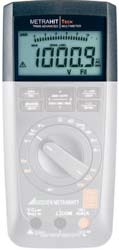
This specifies how many digits of a measurement signal can be displayed by a DMM.
Example:
The DMM displayed on the left is 4 ½ -digits with 12000 digits. 4 full digits from 0-9 are displayed plus one more (here a 1). From a value of 11999 (e.g. 11.999 V), the display automatically switches to the next higher measuring range (100 V).
Mean value indicating DMM:
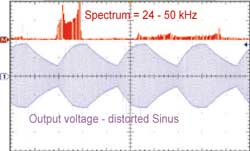
When measuring voltage and current, only pure sinusoidal signals are measured correctly. Due to today's requirements, this is no longer up to date. Even an electronic LV transformer delivers extremely distorted sinusoidal signals on the output side. With such a DMM one gets no or completely wrong values displayed. Therefore a DMM with TRMS should be used. Where may the multimeter be used?
In the operating instructions and printed on the digital multimeter (DMM), you will find information about the environment in which it can be used. The maximum permissible voltages in the ranges (measurement categories) must also be observed.
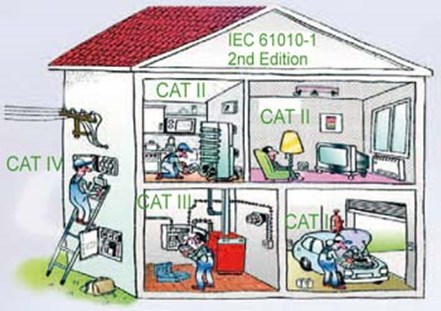
- CAT I Measurements on circuits not directly connected to the mains, e.g. batteries, etc.
- CAT II Measurements on circuits that are electrically directly connected to the low-voltage mains. Via plugs, e.g. in household, office, laboratory …
- CAT III Measurements in building installations. Stationary consumers, distribution connection, devices fixed to the distribution board.
- CAT IV Measurements at the source of low voltage installation. Meters, main connection, primary overcurrent protection devices.
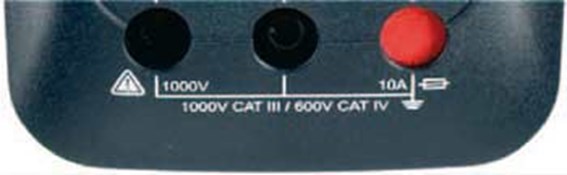
Three sockets with patented Automatic Socket Lock (ABS) 1)
All current measuring ranges are routed via a single socket without any risk of confusion. The Automatic Socket Lock also prevents incorrect connection of the measuring leads or incorrect selection of the measured variable. This largely eliminates any risk to the user, the instrument and the measured object due to incorrect operation. 1) patent protected (patent no. DE 10 2005 062 624, US 7,439,725)
TRMS indicating DMM and bandwidth:
This correctly measures and displays sinusoidal as well as non-sinusoidal signals when measuring voltage and current. Just as important as TRMS is the bandwidth! When measuring AC current and AC voltage, the frequency range of a signal is important. In the example of a halogen LV transformer, a multimeter is needed with a bandwidth greater than 24 kHz.
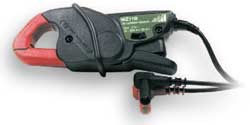
Current measurements > 10A:
Frequently, current measurements must be made that exceed the measured value of the DMM or the current-carrying conductor may or may not be disconnected. A current clamp must be closed at a 90° angle around the current-carrying conductor to achieve the highest measurement accuracy.
Transformer current transformers: only alternating current measurement possible
Hall-effect current sensors: for measuring DC and AC currents Important: The output of these current clamps is a voltage (volts per ampere). Therefore set function switch to VAC+DC! In the setup menu you can set the conversion factor e.g. 1:1000 V / A and the measured current value is then automatically calculated and displayed.
© 2026 GMC Instruments. All rights reserved. | Imprint | Privacy Statement
This website is using cookies. More info.
That's Fine